


Menopause, snoring and fatigue. How are they related?

You fall asleep at a reasonable hour. You wake up when your alarm goes off. You stayed asleep all night. That means you slept well, right?
Not necessarily. And if you are a menopausal woman dealing with fatigue that nobody can quite explain, this might be the piece of the puzzle you've been missing.
Snoring in menopause is far more common than most women realize and far more consequential than most doctors ask about. If you’ve never been told you snore, that doesn’t mean you don’t. It might just mean nobody is in a position to tell you. This blog is my way of doing exactly that.
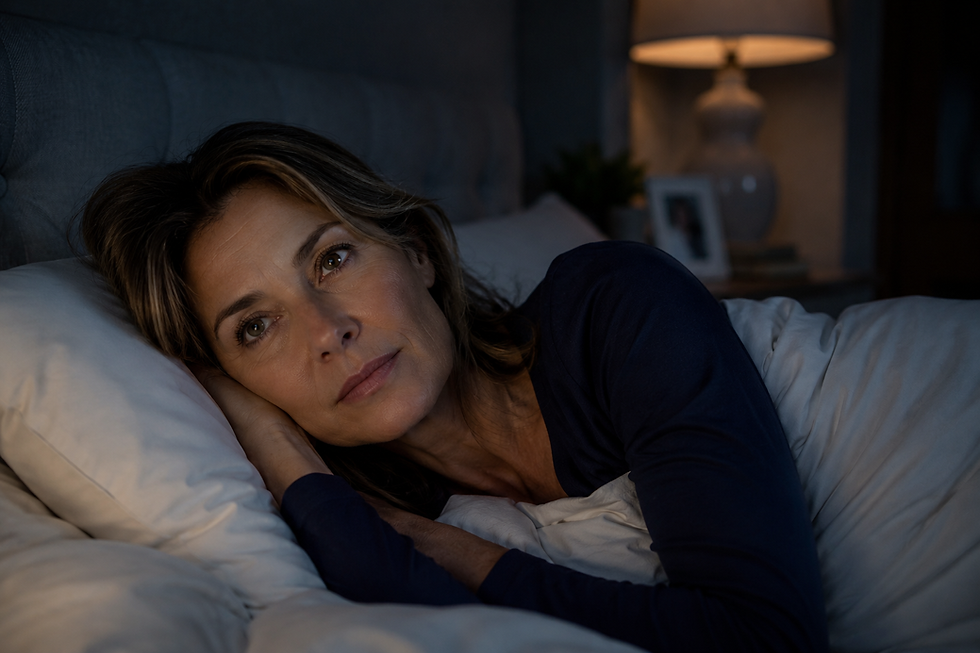
Menopause, snoring and fatigue: How Estrogen Protects Your Airway
Here is something that is rarely discussed, especially with women: estrogen and progesterone both play an active role in keeping your upper airway open during sleep.
Progesterone is a respiratory stimulant. It maintains muscle tone in the soft tissues of the throat and upper airway, keeping them from collapsing inward during sleep. Estrogen appears to support the health and responsiveness of upper airway tissues and contributes to upper airway tone and responsiveness.
When both hormones decline in menopause, the throat muscles relax more than they used to. The soft tissues of the palate, the uvula, and the back of the throat lose some of their tone and resilience. As air moves through a narrower, floppier passage during sleep, it causes those tissues to vibrate.
That vibration is what snoring sounds like.
Before menopause, men are several times more likely than women to have sleep apnea; after menopause, women’s risk increases and approaches that of men of similar age, especially in the 50s and 60s. A postmenopausal woman in her fifties has a sleep apnea risk comparable to a man of the same age. This is a significant and underappreciated shift that most women are never warned about.
Menopause, snoring and fatigue: Why Feeling Tired Is Not Just About Hormones
Fatigue is one of the most common complaints I hear from women in perimenopause and post-menopause, and one of the most frustrating. It is easy to attribute to everything.
When a menopausal woman tells her doctor she is exhausted, the first question is usually: how is your sleep? And most women say: fine. I fall asleep okay. I stay asleep. I wake up when I need to. Many get 8 or more hours of sleep.
What the doctor does not always follow up with, and what women tend to not volunteer, is whether or not she snores. Whether her sleep feels restorative. Whether she wakes up tired despite having been in bed for seven or more hours.
There is a reason for that gap. Most people are reluctant to admit they snore. It does not feel like a health complaint. It feels like an embarrassing habit. And if you sleep alone, or your partner is a heavy sleeper, you may genuinely not know it is happening.
Snoring in menopause is not just an inconvenience. It can be a sign that your airway is partially obstructed during sleep, and that your brain and body are not getting the deep, restorative oxygen they need all night. And that chronic, low-grade oxygen disruption is one of the most underdiagnosed causes of menopausal fatigue.
Being proactive means asking the questions your doctor is not asking. Snoring in menopause is one of them. |
Menopause, snoring and fatigue: How do I know if I snore?
Before your next doctor's appointment, download a snoring detection app and record yourself sleeping.
There are many free snoring apps. One option called Sound Sleep does exactly this. You have it start recording as you fall asleep and stop it when you wake up. The app records continuously, but only captures snippets when it detects snoring sound. When you wake up, you can listen back and hear whether it is light, occasional snoring or something heavier that sounds like a real struggle to breathe.
What the app report will show you:
• The percentage of time you spent snoring during the night
• The percentage of time your breathing was disrupted
• The intensity of the snoring on a 0 to 100 scale
This is not a medical diagnosis. It is information that gives you the language to have a real conversation with your doctor. The recording of your snoring alone is enough to let your doctor know that you snore. If you’re a heavy snorer, it could go beyond fatigue as the lack of oxygen could impact your heart over time so it’s important that you follow-up with a formal sleep study monitored by a physician.
Menopause, snoring and fatigue: Talking to Your Doctor About Snoring
If your app shows you snoring, especially if it sounds heavy or shows significant breathing disruption, bring it up at your next appointment. Do not wait for your doctor to ask. This is exactly the kind of proactive step that can change your health trajectory.
Tell your doctor: "I’m a snorer and I’m concerned as to how that may affect my fatigue as well as my overall health. I would like to be have this evaluated."
Your doctor can order a home sleep test. It works in a similar way to the app you used, but with medical-grade equipment and results that go directly to a sleep clinic for clinical evaluation. Crucially, a home sleep test also measures something the app cannot: your blood oxygen levels throughout the night, using a monitor placed on your finger while you sleep.
Oxygen saturation data is what tells the sleep specialist whether your snoring is actually disrupting your breathing in a clinically meaningful way. That distinction determines what happens next.
Menopause, snoring and fatigue: The Range of Sleep Issues in Menopause
Here is what I want you to hear, because I know it is the thing that stops women from pursuing this: not every sleep problem leads to a CPAP machine. Not even close.
Continuous positive airway pressure (CPAP) is the gold standard for moderate to severe sleep apnea, and modern machines are smaller, quieter, and far more comfortable than the ones from ten years ago. But it is not the only option, and it is often not the first recommendation for women with milder presentations.
Other treatment options your sleep specialist may discuss:
A custom oral appliance — a bite plate made by a dentist trained in sleep medicine that repositions your jaw during sleep, keeping your airway open. This is a common first recommendation for mild to moderate sleep-disordered breathing and many women find it far easier to adapt to than CPAP.
Positional therapy — for women whose snoring and breathing disruptions only occur when sleeping on their back, targeted approaches to sleep position can be surprisingly effective.
Weight management — even modest changes in body composition can reduce snoring severity, particularly fat stored around the neck and upper body.
Addressing nasal congestion — allergic rhinitis and chronic nasal blockage worsen mouth breathing and airway obstruction during sleep. Treating the underlying cause can meaningfully reduce snoring.
Myofunctional therapy — a newer approach using exercises for the tongue and throat muscles that has emerging evidence for reducing mild to moderate sleep apnea severity.
The point is that a sleep evaluation opens a door to options and not just to one device. You do not know which option is right for you until you have the information. And you cannot get the information until you ask. The good news is that insurance should pay for this.
Menopause, snoring and fatigue: Why Snoring in Menopause Gets Missed and What You Can Do About It
Sleep apnea in women can presents as:
Fatigue and daytime sleepiness despite adequate hours of sleep
Morning headaches
Difficulty concentrating and brain fog
Mood changes, irritability, or low-grade anxiety
Waking up feeling unrefreshed
Frequent nighttime waking or insomnia
These symptoms are easily attributed to menopause itself including hormone fluctuations, stress, or the natural aging process. Snoring therefore may not be an area that’s explored. When snoring and sleep-disordered breathing are also present and untreated, the fatigue and cognitive symptoms are compounded by something that is actually fixable.
Being proactive about your health means asking the questions your doctor isn’t. Snoring in menopause is quiet, embarrassing, and easily overlooked. But it is also one of the most straightforward things to investigate once you know to look for it.
You deserve to wake up feeling rested. If you are not, this is worth exploring.
If you need some help or support with your symptoms, Schedule a strategy session here:
References:
Qin, Y., et al. “Obstructive Sleep Apnea: Women’s Perspective.” Sleep Medicine Clinics (review of sex differences in OSA, including menopause and underdiagnosis in women).pmc.ncbi.nlm.nih
Hachul, H., et al. “Global Prevalence of Sleep Disorders During Menopause.” Menopause (systematic review of insomnia, snoring, and sleep apnea in peri‑ and postmenopausal women).pmc.ncbi.nlm.nih
Young, T., et al. “Menopausal Status and Sleep‑Disordered Breathing in the Wisconsin Sleep Cohort Study.” American Journal of Respiratory and Critical Care Medicine (shows increased sleep‑disordered breathing after menopause, independent of age and BMI).academic.oup+1
SnoreLab. “Snoring and Sleep Apnea in Women.” SnoreLab Insights (lay overview of how snoring and sleep apnea present differently in women and how risk changes around menopause).snorelab
SleepQuest. “Menopause and Sleep Apnea: Hormonal Changes Explained.” SleepQuest (explains how declining estrogen and progesterone affect airway stability and sleep apnea risk in midlife women).sleepquest
Sleep Foundation. “What Causes Snoring in Women?” Sleep Foundation (consumer‑friendly explanation of snoring causes, risk factors, and treatment options for women).


Comments